9 Most Common Link Building Scams (And How To Avoid Them)
A crash course for business owners on the most common link-building scams and how to spot them before losing money.
As a business owner, you’re probably bombarded daily by offers to:
- Place guest posts on your website.
- Buy backlinks.
- Participate in link exchanges.
If you’re already doing SEO for your company, you’re likely spending 30-50% of your SEO budget on link building. Or maybe you’re just starting to learn what backlinks are and how they work.
In either case, I’ve decided to create a crash course on backlinks specifically for business owners.
As part of it, this article focuses on the common “tactics” shady link-builders use.
In case you want to know what a good backlink is, here’s a to-the-point explainer.
Calling “scams” to some of these tactics might sound harsh, but when you pay for link-building, and all you get are links with no real value, calling them “scams” makes absolute sense.
Without further ado, let’s dive right in.
Common Link Building “Scams”
Here are the nine most common link-building scams every business owner should be aware of:
#1. Huge Markups for Worthless Links
Many link sellers quote high prices for links they buy from guest-posting marketplaces.
Sometimes, the number of resellers in the chain are so high the markup can get as costly as 15X or higher from its source price.
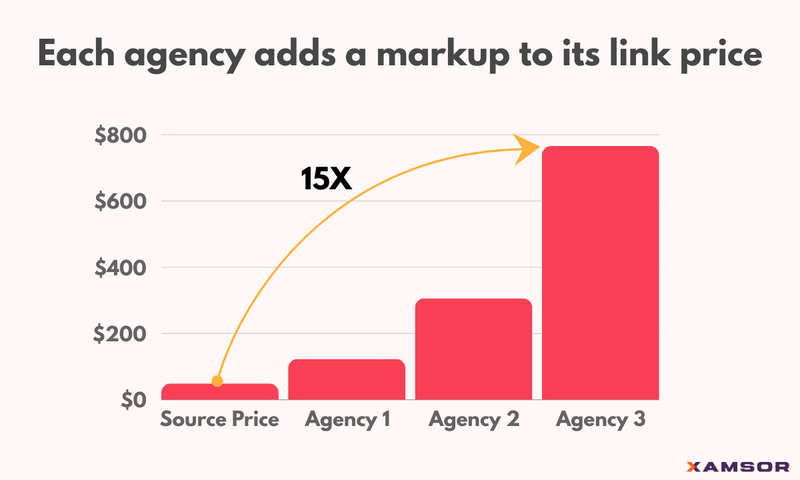
You end up paying a steep link price for such a poor backlink.
To avoid paying such inflated prices, you can check the fair value of a link here.
#2. “Link Exchange” with Marketplace Websites
Here’s how a link “exchange” works:
You link out to a site in exchange for a link back from that or another site. A three-way link-exchange looks like: A to B, Bto C, and C to A.
With the link sellers involved, they ask you to link to one of their clients’ sites in exchange for a link back to your site from another client’s site.
But this is where the “scam” happens.
You link to their client’s site. But what you get back is a link from one of the marketplace websites.
You link to their client site but get a link back from a spam site.
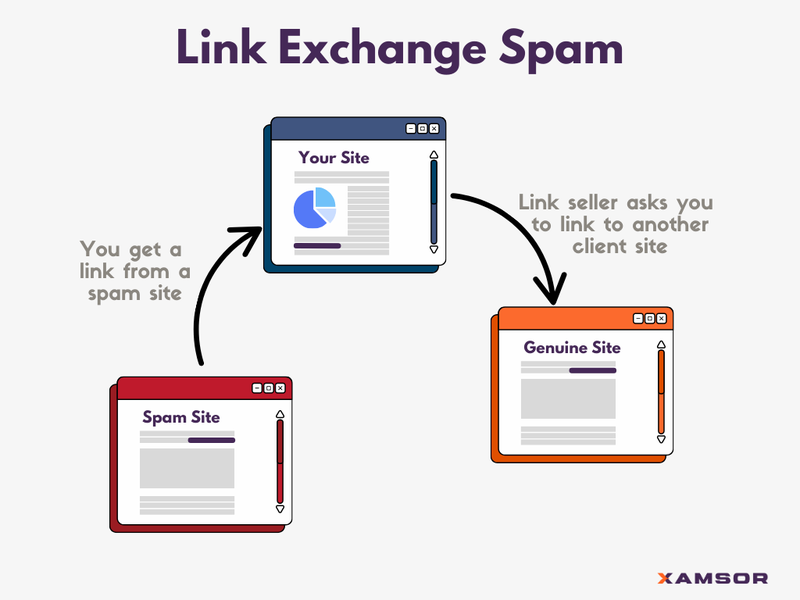
Instead of a link from a genuine site, you get a worthless marketplace site backlink.
#3. PBNs Disguised as Real Sites
A private blog network (PBN) is a network of sites created solely for link-building purposes.
Link builders promise a link from “authority” sites and all they do is link from these PBNs.
These types of links are bad for two reasons.
First, they are a waste of money, they do nothing. Second, Google doesn’t like them and, once caught, punishes these sites—used to at least.
But most of all, these links have no value. PBN sites get no organic traffic, all the domain “authority” metrics are inflated, and in most cases, if you visit the domain—you won’t even see a working site.
#4. “Real Outreach” That Isn’t Real
Manual outreach is a good way to build backlinks. It takes time and effort though.
Many sellers claim they do actual “outreach”, pitching authority sites and bloggers, but all they do is place links on paid guest-post platforms or link farms.
We experienced this “outreach” when we tried out Fatjoe’s link-building service. A link that was available for just $50 on Collaborator.pro. Add in copywriting cost of another $50 (the content turned out to be likely AI though), the cost adds up to $100.
The Hoth charged us $230 for what’s obviously a non-outreached link.
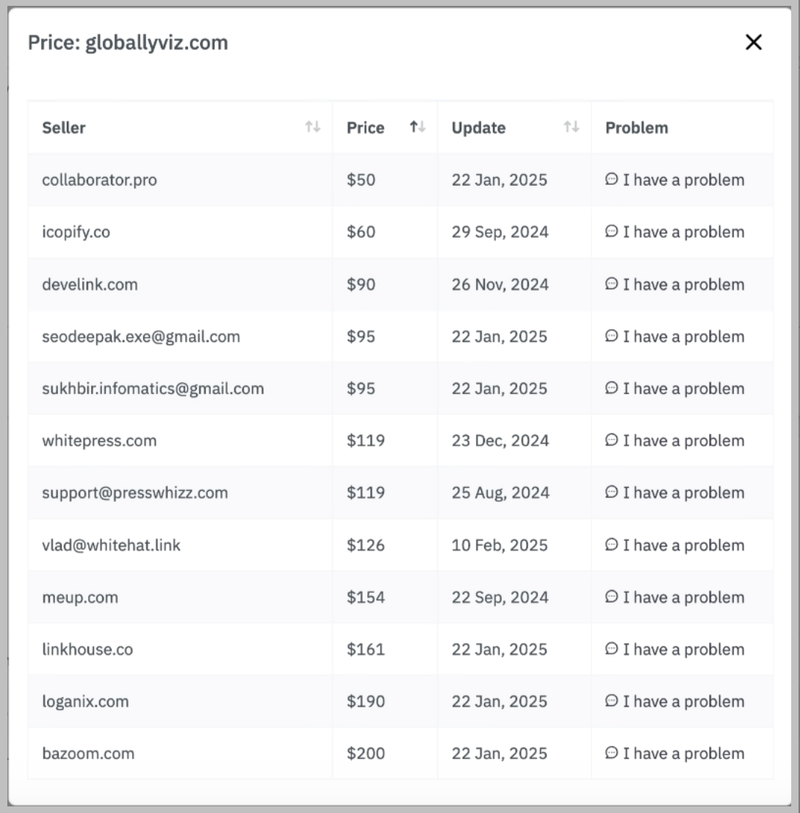
That’s not even the shocking part.
The HOTH promised the publisher site would have a minimum monthly traffic of 1,000. But according to Semrush, the site traffic was less than a 1,000.
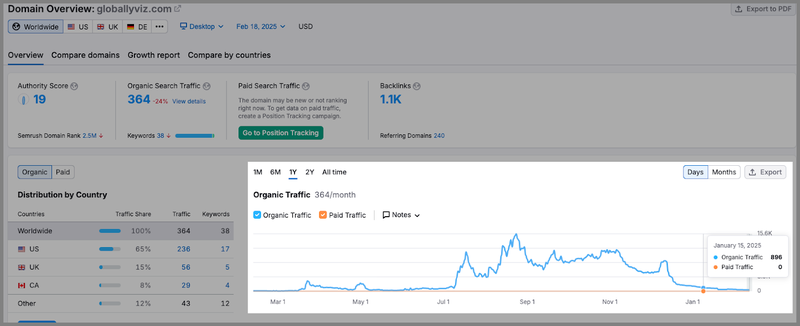
All this from a “real outreach.”
#5. Sites with Manipulated Metrics
High Ahref DR or Moz DA doesn’t always mean high quality. These metrics can be inflated easily, as our backlinks research shows.
There’s a reason link-builders are so fond of Ahrefs DR or Moz DA. But rarely use Semrush AS, which is far more difficult to manipulate.
The manipulated DR/DA sites provide no real link juice. They have zero traffic, rank for zero keywords, and have backlinks only from a handful of other sites with inflated DRs.
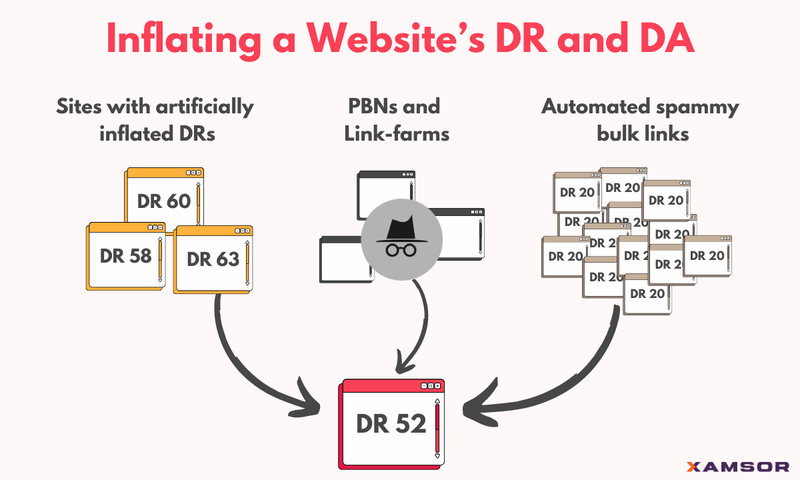
Link-builders keep on inflating DRs. One spam site rebirths another. One inflated DR site gives birth to another inflated DR site, and the cycle continues. The link-sellers keep selling links from them.
#6. Redirect Scams
Redirect links are quite advanced. Here’s how they operate:
First, link-builders own websites or old domains taht high authority sites have a link to.
Next, when you place an order, the link-seller 301 redirects from their old domain to your site.
Then, they show you backlink as coming from the high-authoirty site on SEO tools like Semrush and Ahrefs.
To SEO tools like Semrush and Ahrefs, it looks like the link came from the big “authority” site to your site, since the the domain the authority site linking to is 301 redirected to your site.
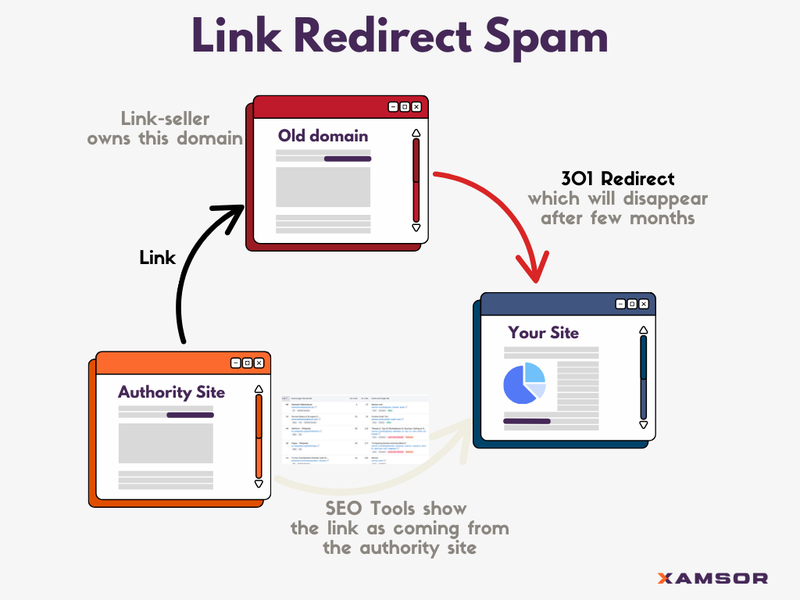
And after a few months, the link-seller will remove the redirect, and repeat the same with another client.
To their credit, if you dive deep into these SEO tools, they do show where the link is actually coming from. They can be caught.
But most owners won’t bother to check these links.
As a quick check, you can use a backlink verification tool.
#7. Fake Editorial Links
Editorial links on big media publications are another link-building scam. Of course, not all editorial links are scams, but enough of them are to merit a place here.
Link-sellers market editorial links on large news publications like Forbes, Entrepreneur, TechCrunch, etc.
And they market these links as organic placements earned through genuine outreach. But here’s what goes on:
A “contributor post” from a freelance writer sneaks a link on a big media publication to your site. Some of these posts are from hacked author accounts. I talk about hacked accounts in detail next.
But what ends up happening is that the post eventually gets deleted once the news publication identifies it.
The business owner, who probably paid an extremely high price for this link, ends up with no link after a few months.
#8. Link Insertion on Hacked Sites
Some link-builders hack other people’s websites. And use these hacked sites to insert links.
The hacked sites have decent traffic and domain authority metrics, and link-sellers use these metrics to sell links.
Except, the actual site owner has no idea their site is used for link-building.
So, beware of these spam link injections into hacked sites. Both as a buyer and site owner.
#9. Directory Links – 50 links for $50
Many link-sellers offer ridiculously low-cost links. You find them mostly on platforms like Fiverr, Upwork, and Facebook groups.
These sellers offer “100 backlinks for $20” or similar garbage.
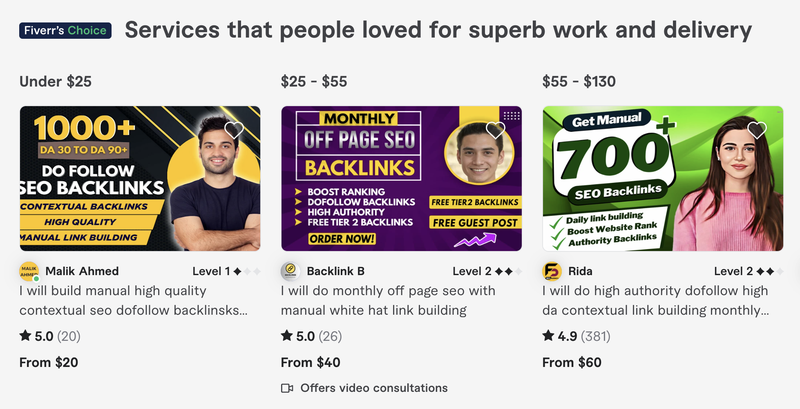
What you actually get are directeory links often in the form of forum profiles. Or even worse, blog comments.
These directory links do nothing to your site. Business owners go for these services seeing such ridiculously low prices for such a high volume of links. But they end up paying for nothing.
General Signs of Link Building Scams
Here are some of the signs you can spot if the links you are offered are not genuine, and most likely a rip-off.
- No traffic to the site: No #1 metric to spot worthless links.
- Automated outreach emails: If your link-seller reached out to you via an obviously fake name with a generic personal email id, you’re in for some spammy link-building.
- High DR/DA but low-to-zero traffic: The inflated site metrics to set the link price and yet have no real audience.
- AI-generated poor quality content: The site is full of AI-generated content, painful and incoherent to read.
- Reluctant to share the URL: Link-builders show the linked site on Ahrefs and Semrush rather than sharing the URL directly.
- Too many outbound links: The URL that’s linking to your site is littered with too many outbound links.
- Too cheap or too expensive: A $50 for 50 links on Fiverr and $5000 for an editorial link placement on Forbes—both offers are to be cautious of.
The Right Way to Build Backlinks
With these many scams and shady link-building going around the block, how do you approach link-building then?
The best link-building methods are—digital PR, building useful resources and tools, and smart internal linking (often the best links are from your own site).
You can still go for link-building as long as you vet the links or the service provider properly.
To check the fair price for a backlink from any site, you can use tools like GetLinks.Pro. This will allow you to find the fair link price and avoid any markups that link-builders ask for.
And in case you’re still looking for a trusted link-building service, you can try LinkBuilders.us. A shameless plug, but I believe we provide a reliable and trusted link-building service. Go check it out.
I hope this is helpful. Please share your thoughts on Linkedin. And subscribe to our newsletter.

Max Roslyakov
Founder, Xamsor