How To Write a Blog Introduction (5-Step Formula to Grab Readers' Attention)
A five-step formula for writing blog introductions that hook readers, based on lessons from writing 500+ posts.
You should create boring intros for your content.
If you want to lose your readers.
Now I have your attention, and you encountered the “hook”—the first element of the blog post introduction that fuels the reader’s interest.
In this post, you’ll learn the 5-step formula to create blog introductions that grab readers’ attention.
We’ve learned what keeps readers engaged after writing over 500 blog posts. You can apply this introduction framework anywhere you want people to stay interested in your content.
This article outlines the PPP (Promise, Proof, Path) framework and shows the exact steps to create better blog intros.
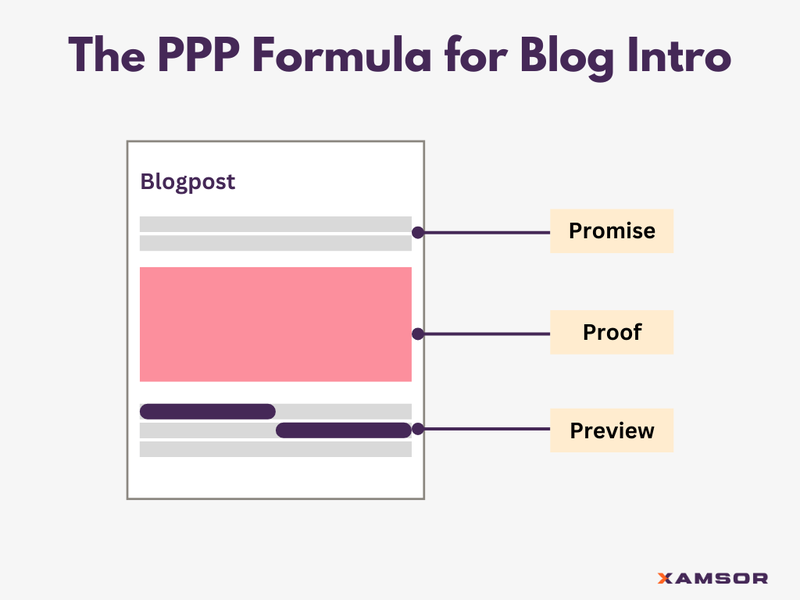
Without further ado, let’s get into it…
1. Hook
Before diving into the PPP Framework, start with a strong hook.
This could be a surprising statistic, a thought-provoking question, or a bold statement immediately grabbing the reader’s attention.
For example: “Did you know that 55% of visitors spend less than 15 seconds on a webpage?”
Or, consider posing a question that makes the reader pause and reflect.
For instance: “What if you could double your blog traffic in just 30 days?”
Remember, the key to an effective hook is relevance. While it should be attention-grabbing, it must also be directly related to the content of your blog post.
The best hook is personal, relevant and “cold” – it should trigger an emotional response.
2. Promise
The PPP (Promise, Proof, Path) framework begins with Promise.
Here, you should give readers a clear overview of what to expect from your post. This will help them quickly determine whether the content is relevant to their needs.
For example, you might say, “In this post, you’ll learn five proven strategies to boost your website’s conversion rate.”
Be direct and give the reader exactly what they are here for.
3. Proof
Next, you can establish your credibility with proof.
The goal is to show readers your credibility and what you can offer. This can be done with:
- Personal results (e.,g. case studies)
- Years of experience
- Previous client success stories
- Other relevant credentials
In our post on content audits, the proof is provided with case study results and success stories.
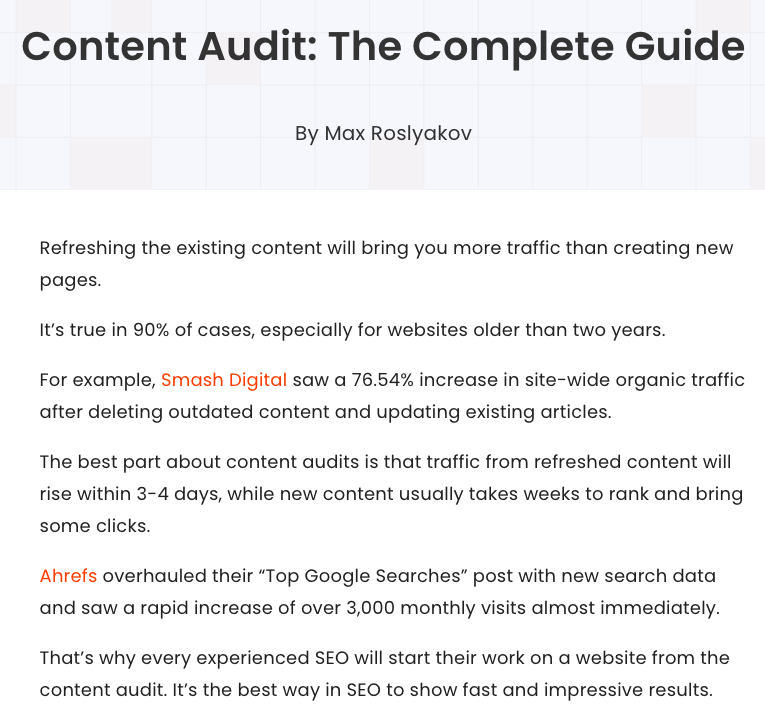
Both of these studies give away proven tactics to grow blog traffic. They work, and readers can benefit from them.
4. Preview
Conclude your introduction with Path or Preview.
This highlights a more specific overview of what’s to come later in your blog.
You might say, “This guide will show you how to optimize your call-to-actions and the step-by-step process to increase click-through rates.”
This helps build anticipation and encourages readers to continue.
5. Transition
Finally, you can end the intro with a simple transition sentence. This sentence acts as a bridge between your introduction and the main body of your content.
For example, you could write, “Let’s jump right in…”
In our experience, this boosts engagement and drives the reader to the body of our blog post.
Blog Introduction Best Practices
Mastering blog introductions is how you can boost your content’s engagement. Here are a few best practices to create more compelling blog intros.
Keep It Concise
Aim to keep your introduction brief and to the point. Ideally, a blog intro should be between 4-7 sentences.
A concise introduction respects the reader’s time, hooks their attention, and gently guides them into the body of the blog. In our experience, the most effective blog intros are fewer than ten lines.
This is more than enough to grab the reader’s attention and convince them to keep reading past the intro.
Tease the Content
Give readers a taste of what’s to come without revealing all your insights. This is where the PPP framework is so effective.
It is good to tease the reader about what the post will offer without giving it all away too soon. You want readers to get some value and anticipate more, so they’ll scroll down the screen.
Deliver on What You Promise
Finally, you must deliver what you promise.
If you tell the reader in the intro, they’ll learn how to score high-quality backlinks in your post, then be sure the article does exactly that.
Misleading introductions can lead to disappointed readers and loss of their trust.
Is there anything missing in this article? Feel free to join the discussion on LinkedIn.
Want to get notifications about the new posts? Subscribe to the e-mail newsletter.

Max Roslyakov
Founder, Xamsor